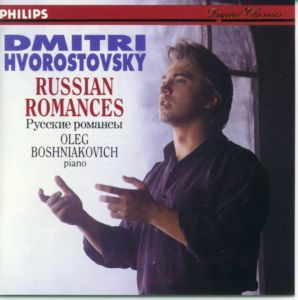
|
|
| 01 |
(Snova, Kak Prezhde'E, Adin), Op. 73 No. 6 |
|
|
|
02:30 |
|
| 02 |
(Salavej), Op. 60 No. 4 |
|
|
|
03:17 |
|
| 03 |
(Podvik), Op. 60 No. 11 |
|
|
|
03:48 |
|
| 04 |
(Rastvaril Ja Akno...), Op. 63 No. 2 |
|
|
|
01:46 |
|
| 05 |
Serenada Don Zhuana, Op. 38 No. 1 |
|
|
|
02:47 |
|
| 06 |
Son, Op. 8 No. 1 |
|
|
|
01:36 |
|
| 07 |
(Ana Kak Polden' Harasha), Op 14 No. 9 |
|
|
|
02:51 |
|
| 08 |
(Ne Poj, Krasavitsa, Pri Mne), Op. 4 No. 4 |
|
|
|
04:21 |
|
| 09 |
(O, Net, Mal'U, Ni Uhadi!), Op. 4 No. 1 |
|
|
|
01:46 |
|
| 10 |
Primiren'Je, Op. 25, No. 1 |
|
|
|
05:19 |
|
| 11 |
(Sieza Drazhyt F Tvajom Rivnivam Zvore), Op. 6 No. 4 |
|
|
|
03:42 |
|
| 12 |
(Net, Tol'Ka Tot, Kto Znal), Op. 6 No. 6 |
|
|
|
03:08 |
|
| 13 |
Strashnaja Minuta, Op. 28 No. 6 |
|
|
|
03:41 |
|
| 14 |
(Fchira My Fstretilis'), Op. 26 No. 13 |
|
|
|
02:46 |
|
| 15 |
V Malchan'Ji Nochi Tajnay, Op. 4 No. 3 |
|
|
|
02:44 |
|
| 16 |
(Fs'O Otn'Al U Min'A), Op. 26 No. 2 |
|
|
|
01:14 |
|
| 17 |
Atryvak Iz A. Musset: (Shto Tak Usilenna), Op. 21 No. 6 |
|
|
|
02:00 |
|
| 18 |
(Hristos Vaskres), Op. 26 No. 6 |
|
|
|
02:45 |
|
THE LYRICAL IDEA
Although Tchaikovsky's popularity has seldom been more widespread than it is today, only his grandest scores - the big orchestral pieces, the
operas and ballets - have received their proper due outside Russia. Yet
the composer's fundamental genius, something he himself called "the
lyrical idea," is nowhere more perfectly expressed than in his songs.
Cultural barriers of every kind have limited our access to them, and it
may be that only native singers can do justice to their uncommon beauty;
for while Lieder and melodies are often idiomatically performed by
artists who speak not a word of German or French, the Russian romans, of
which Tchaikovsky was the supreme master, still tends to intimidate and
elude non-Slavic singers.
There is some irony in this. Tchaikovsky's earliest critics were his
compatriots - the "mighty handful" of composers whose spokesman was
Cesar Cui - and they found his songs decidedly un-Russian. They accused
him of being careless and capricious in his word-setting ("false
declamation" was the official charge), and more interested in aping
German trends in music than in building on the patrimony left them by
Glinka. Later critics, Russian and otherwise, argued that Tchaikovsky's
mournful disposition gave his songs a fatal sameness; and while the
poems he chose to set drew great music from him, the resulting beauty
was, they felt, too monochrome, too circumscribed. By 1901, less than a
decade after the composer's death, Ernest Newman offered a rebuttal:
"There are more shades of melancholy than one, more paths than one to
despair, and for each of these Tchaikovsky finds a new scheme of
expression."
But even Newman had to acknowledge that "Once again, as before, I am
alone" (the last of Tchaikovsky's songs, and the first heard in this
recital) unwinds like "a long, insistent demonstration in the logic of
the emotions, leading to an unassailable conclusion." And that
conclusion - utter despair - seems to sum up the prevailing mood of the
best of Tchaikovsky's earlier songs, while reinforcing the stereotype
that he was a purveyor of unremitting grief. The obsessive quality of
"Once again, as before, I am alone" owes much to the composer's
characteristic use of ostinato, but in "Nightingale," this device takes
on a very different function. Here, motivic reiteration links
Tchaikovsky's own musical language to that of Russian folk song, and as
a supple reworking of a native genre, "Nightingale" (pace Cui and his
colleagues) suggests that Tchaikovsky was far more responsive to
nationalistic influence than his image as a westernised composer would
have it.
"Heroism," while dating from the same prolific year as "Nightingale," is
worlds away in tone and structure. "What a poet!" Tchaikovsky wrote
after setting Khomyakov's text. "I feel my music, too, has turned out
successfully." Indeed it had, but unless it is put across with utter
conviction, the heroic ardour of the piece rings false, and only
inspired singing can make us believe in it as fully as the poet and the
composer did.
In their differing ways, both "I threw open the
window" and "Don Juan's Serenade" challenge the standard view of
Tchaikovsky as an inveterate tragedian. The first song is one of a group
written to poems by the Grand Duke Konstantin, a gracefully crafted
cycle typical of the 4'cosmopolitan Tchaikovsky" Cui and his colleagues
so deplored; and yet, for all that they derive their charm from French
examples, these romances may be admired as salon music of a superior
sort. "Don Juan's Serenade," in contrast, is proof that Tchaikovsky
could be as extroverted in a song as he was in the theatre. A bravura
piece of swashbuckling gait and gesture, it allows a singer of
appropriate gifts to set the character before us, showing where the
brutal and erotic meet in Don Juan's psyche, while unfurling a voice of
operatic amplitude and thrust.
Cui's doubts about Tch